
Quick reference
| Item | Hot-dip galvanising | Powder coating | Duplex | Source |
|---|---|---|---|---|
| What it is | Steel dipped in molten zinc | Powder sprayed on and oven cured | Powder (or paint) over galvanising | |
| How it protects | Barrier plus sacrificial zinc | Barrier only | Both | |
| Colour | Silver grey, dulls over time | Any RAL colour and gloss | Any RAL colour and gloss | |
| Damage | Zinc protects small scratches | Rust can creep under chips | Zinc under the coat protects | |
| Thickness | 85µm min mean on steel over 6mm | Set by the specification | Zinc plus coat | BS EN ISO 1461 Table 3 |
| Main standard | BS EN ISO 1461 | BS EN ISO 12944 (paint systems) | BS EN 13438, BS EN 15773 | |
| Lead time | Adds a trip to the galvaniser | Usually shortest | Longest: both processes | Qualitative |
| Cost | Moderate | Usually lowest | Highest first cost | Qualitative |
Key points
- Galvanising protects by barrier and by sacrificial zinc; powder coating by barrier only.
- BS EN ISO 1461 requires a mean of at least 85µm of zinc on steel over 6mm thick.
- Galvanising life depends on the corrosivity category, from C1 (very low) to CX (extreme).
- Duplex systems give colour and the longest life, at the highest first cost and lead time.
Terms explained in the A–Z glossary.
Download
Two-page summary of the figures on this page, with sources. Free to share with credit to Koyda Ltd.
How the three systems work
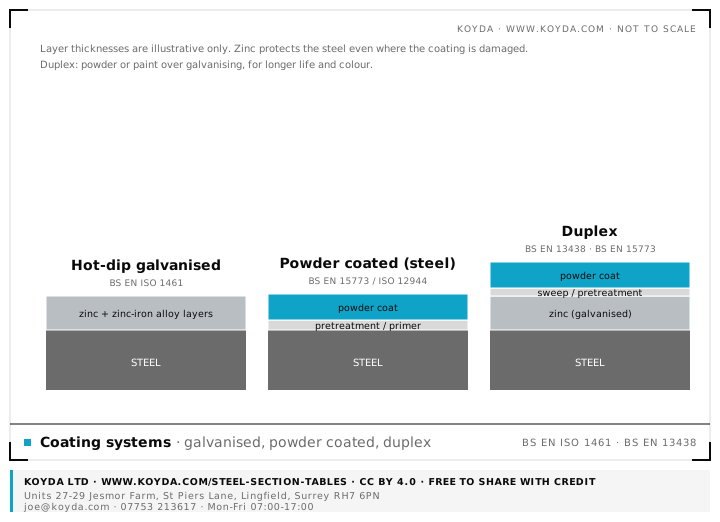
Need the area to coat? The paint and galvanising area calculator gives m² per metre and totals for a list of sections.
Corrosivity categories and galvanising life
Zinc corrosion rates are first-year rates from BS EN ISO 9223. Estimated life is an 85µm coating (the BS EN ISO 1461 minimum on steel over 6mm) divided by the rate. Real life is often longer, because zinc corrodes more slowly after the first year.
| Category | Corrosivity | Typical environment | Zinc loss (µm/yr) | Estimated life, 85µm |
|---|---|---|---|---|
| C1 | Very low | Heated interiors | ≤0.1 | More than 100 years |
| C2 | Low | Rural areas, unheated buildings | 0.1–0.7 | More than 100 years |
| C3 | Medium | Urban and light industrial, low-salt coastal | 0.7–2.1 | 40 to over 100 years |
| C4 | High | Industrial, coastal | 2.1–4.2 | 20–40 years |
| C5 | Very high | Aggressive industrial, coastal with high salt | 4.2–8.4 | 10–20 years |
| CX | Extreme | Offshore, extreme industrial | 8.4–25 | 3–10 years |
Galvanising thickness (BS EN ISO 1461)
| Article | Local min (µm) | Mean min (µm) |
|---|---|---|
| Steel over 6mm | 70 | 85 |
| Steel over 3mm up to 6mm | 55 | 70 |
| Steel 1.5mm up to 3mm | 45 | 55 |
| Steel under 1.5mm | 35 | 45 |
| Castings 6mm or more | 70 | 80 |
| Castings under 6mm | 60 | 70 |
Paint and powder durability (BS EN ISO 12944)
BS EN ISO 12944-1 sets durability ranges to the first major maintenance: low (up to 7 years), medium (7 to 15), high (15 to 25) and very high (over 25). These help choose a system. They are not guarantees.
Coastal and inland sites
- Inland, sheltered sites: galvanising alone is often enough where colour is not needed. Powder on bare steel suits internal work.
- Coastal and exposed sites: salt speeds up corrosion. Duplex is the usual choice where colour is needed outside.
- Avoid details that trap water or debris, whatever the coating.
Designing for galvanising
- Hollow sections need vent and drain holes. BS EN ISO 14713-2 gives guidance.
- Check that each piece fits the galvaniser's bath, or plan joints to suit.
- Thin plate and asymmetric sections can distort in the bath. Ask your fabricator early.
- Specify duplex at the start, so the galvaniser and coater know the finish required.
Frequently asked questions
Is galvanising better than powder coating for outdoor steel?
For corrosion protection alone, galvanising usually lasts longer because the zinc protects the steel even where it is scratched. Powder coating on bare steel relies on an unbroken film. For colour and long life outdoors, a duplex system (powder over galvanising) is the usual choice.
Can you powder coat galvanised steel?
Yes. This is a duplex system. The galvanised surface needs the right preparation before coating, and BS EN 13438 and BS EN 15773 cover the powder and its application. Use a coater who works to these standards to avoid poor adhesion or pinholes.
How long does galvanising last?
It depends on the coating thickness and the environment. Using first-year zinc corrosion rates from ISO 9223, an 85 micron coating could last more than 100 years in a dry rural (C2) setting, roughly 20 to 40 years in a C4 coastal or industrial setting, and less in harsher marine conditions. These are estimates, not guarantees.
What corrosivity category is my site?
BS EN ISO 9223 and BS EN ISO 12944-2 classify atmospheres from C1 (very low, heated interiors) to CX (extreme). Many sheltered inland sites fall in C2 or C3; sites near the sea or with de-icing salts can be C4 or C5. The specifier or engineer should set the category for the actual site.
How much longer does a duplex coating last?
The American Galvanizers Association reports that a duplex system typically lasts 1.5 to 2.3 times the sum of the lives of the galvanising and the paint or powder used alone. The higher figure applies in milder environments.
Sources
- Galvanizers Association: BS EN ISO 1461 coating thickness requirements
- BS EN ISO 9223:2012 corrosion of metals and alloys: corrosivity of atmospheres (BSI)
- BS EN ISO 12944-1 and -2:2017 paints and varnishes: corrosion protection of steel structures by protective paint systems (BSI)
- BS EN 13438:2013 powder organic coatings for hot dip galvanised or sherardised steel products for construction purposes (BSI)
- BS EN 15773 industrial application of powder organic coatings to hot dip galvanized or sherardized steel articles (duplex systems) (BSI)
- American Galvanizers Association: how long does hot-dip galvanizing last
- American Galvanizers Association: duplex systems, synergistic effect
- Galvanizers Association: duplex coatings
General guidance only, not design advice for a specific project. Building regulations guidance changes: check the current edition of each document, and get project-specific design from a competent engineer. Koyda Ltd accepts no liability for decisions made using this page.