Root run straight up into the corner; weave the later layers side to side, pausing at each toe.
7018: DC+, short arc, rods from the oven or quiver. Restart ahead of the crater and move back into it.
Common mistakes
Undercut at the toes: pause longer at the sides.
Metal spilling down: lower the amps or move up faster.
Cold root: get right into the corner on the first run.
Wear your welding respirator and PPE every time you weld.
Typical starting point for mild steel. Follow the job's WPS and the maker's data. Test on scrap first.
Koyda Ltd, Units 27-29 Jesmor Farm, St Piers Lane, Lingfield, Surrey RH7 6PN
joe@koyda.com · 07753 213617 · www.koyda.com
Quick answer
Vertical-up 6 mm fillet: one pass with a slight triangular weave (3.2 mm rod, or 1.0 mm MIG wire). Vertical-up 8 mm fillet: typically two passes, a straight root run into the corner, then one weave cap (an experienced welder can lay it in one heavy triangular weave). A root plus two side-by-side vertical runs also works, but there are more run edges to fuse and more places for slag, so we recommend the weave cap. Always weld upwards: vertical-down is not for structural fillets. Leg z is what the drawing gives as '6 mm fillet'; the throat a is about 0.7 × z. Use the weld finder below for amps, angles and tips for any size and position.
Cite this: Koyda Ltd, “Interactive Welding Guide: Fillet Welds, Stick and MIG”, https://www.koyda.com/guides/welding-quick-guide/, reviewed 11 October 2026.
Quick reference
Leg z (mm)
Throat a ≈ 0.7 z (mm)
Leg z (mm)
Throat a (mm)
3
2.1
8
5.7
4
2.8
10
7.1
5
3.5
12
8.5
6
4.2
Key points
Drawing says '6 mm fillet' = leg length z. Throat a ≈ 0.7 × z.
Vertical: always weld upwards. 6 mm = one weave pass; 8 mm = root + weave cap.
Horizontal: 6 mm = one run; 8 mm and up = root + 2 runs, bottom plate first.
Stick: 7018 on DC+, kept dry. Vertical and overhead: lower half of the amp range.
MIG: 0.8 mm for small welds, 1.0 mm for 5 mm legs and up. Gas 12–16 l/min.
These are typical starting points. The job's WPS and the maker's data come first.
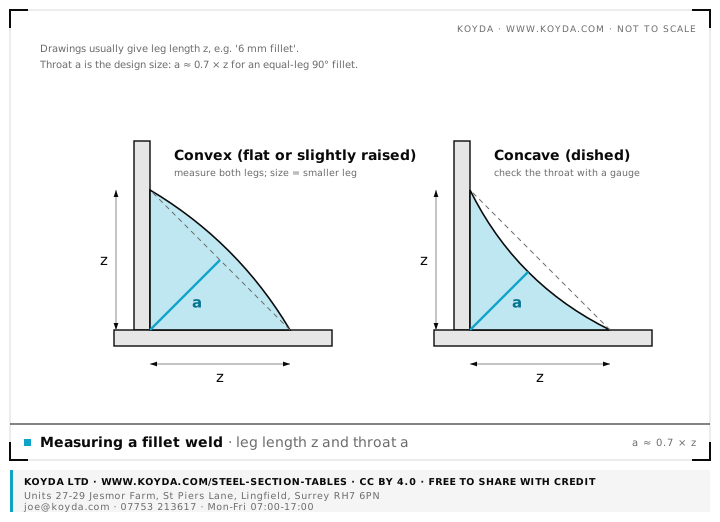
Leg length z: along each plate, from the root to the toe. The drawing's '6 mm fillet' is usually z. On ISO 2553 drawings, 'z6' is a leg and 'a4' is a throat (see welding symbols).
Throat a: from the root to the face. For an equal-leg 90° fillet, a ≈ 0.7 × z, so a5 needs about a 7 mm leg.
Use a fillet gauge on both legs. If the legs differ, the smaller one is the size.
Convex (raised) welds: measure the legs. Concave (dished) welds: check the throat too.
How many passes: by size and position
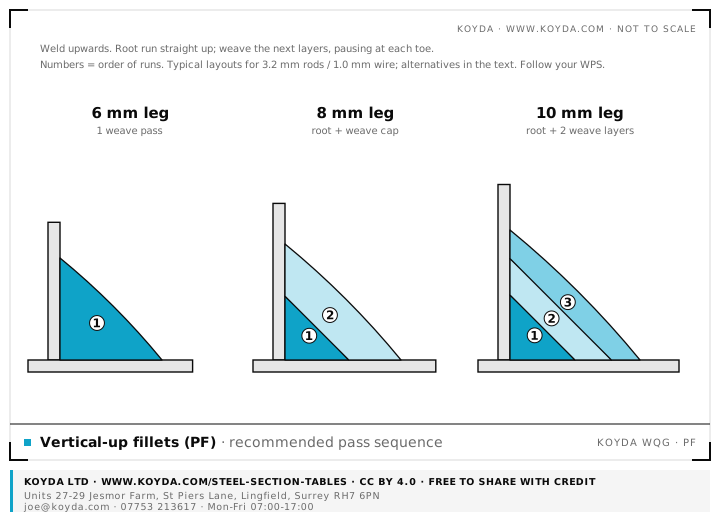
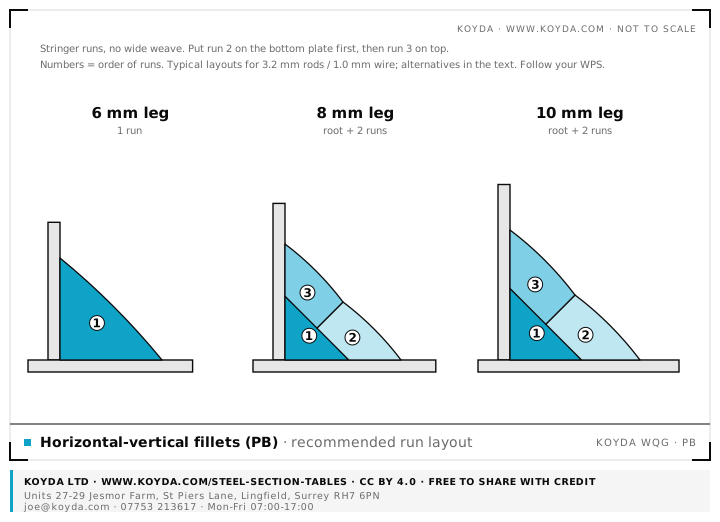
Typical layouts we use. One root run goes into the corner first; later runs build out the leg. Clean the slag off every run.
Recommended vertical-up (PF) pass sequence for 6, 8 and 10 mm fillets. Not to scale. Download the diagram (SVG).
Stick (MMA): layout and rod size
Leg z
Flat (PA)
Horizontal (PB)
Vertical-up (PF)
Overhead (PD)
3 mm
1 run · 2.5
1 run · 2.5
1 run · 2.5
1 run · 2.5
4 mm
1 run · 3.2
1 run · 3.2
1 run · 2.5
1 run · 2.5
5 mm
1 run · 3.2
1 run · 3.2
1 pass, weave · 3.2
1 run · 2.5
6 mm
1 run · 3.2
1 run · 3.2
1 pass, weave · 3.2
1 run · 3.2
8 mm
1 run · 4.0
root + 2 runs · 3.2
root + weave cap · 3.2
root + 2 runs · 3.2
10 mm
root + weave cap · 4.0
root + 2 runs · 4.0
root + 2 weave layers · 3.2
root + 3 runs · 3.2
12 mm
root + 2 runs · 4.0
root + 2 + 3 runs · 4.0
root + 3 weave layers · 3.2
root + 2 + 3 runs · 3.2
Rod sizes in mm, for 240 V and three-phase sets. On a 110 V set, use 3.2 mm where the table says 4.0 and add runs (the finder adjusts this).
MIG: layout
Leg z
Flat (PA)
Horizontal (PB)
Vertical-up (PF)
Overhead (PD)
3 mm
1 run
1 run
1 run
1 run
4 mm
1 run
1 run
1 run
1 run
5 mm
1 run
1 run
1 pass, weave
1 run
6 mm
1 run
1 run
1 pass, weave
1 run
8 mm
1 run
root + 2 runs
root + weave cap
root + 2 runs
10 mm
root + weave cap
root + 2 runs
root + weave cap
root + 3 runs
12 mm
root + 2 runs
root + 2 + 3 runs
root + 2 weave layers
root + 2 + 3 runs
Recommended horizontal-vertical (PB) run layout for 6, 8 and 10 mm fillets. Not to scale. Download the diagram (SVG).
Typical layouts for 3.2 mm rods and 0.8–1.0 mm wire, chosen to be easy to get right. They are on the cautious side: Lincoln Electric's 7018 procedure lays vertical-up fillets up to 12 mm in one triangular-weave pass (4.0 mm rod above 8 mm), and BOC teaches a straight first run followed by "either numerous straight runs or several wide weaving runs". With 4.0 mm rods on a 240 V or three-phase set, one layer fewer is common from 10 mm up. The finder shows the accepted alternative on each card.
Weave width: vertical-up layers are woven across the full face. AWS D1.1 prequalified procedures split a layer into side-by-side runs only when it is wider than 25 mm in the vertical position, or 16 mm flat, horizontal and overhead, so in flat and horizontal work keep weaves small. Single-pass upper limits in AWS D1.1 (stick: 10 mm flat, 8 mm horizontal, 12 mm vertical, 8 mm overhead) are maximums for qualified procedures, not targets.
Stick (MMA)
Which rod: 6013 or 7018
E6013 (rutile): easy to strike, smooth finish, AC or DC−. General and light fabrication, gates, brackets, sheet. Example: BÖHLER FOX OHV.
E7018 (low-hydrogen): tougher weld, DC+. Structural steelwork, thicker plate, and wherever the WPS says. Example: BÖHLER FOX EV 50.
Keep 7018 dry: in the oven or a heated quiver, not loose in the box. Redry as the maker says (FOX EV 50: 300–350 °C, 2 hours). Damp 7018 gives porosity and can cause cracking.
7018 restarts: strike just ahead of the crater, move back into it, then carry on. Keep a short arc; don't whip or stretch it.
Amps by rod (typical, from Böhler data sheets)
Rod
Type
Flat / horizontal
Vertical-up / overhead
Polarity
2.5 mm
E6013
60–100 A
60–80 A
DC− or AC
3.2 mm
E6013
90–130 A
90–110 A
DC− or AC
4.0 mm
E6013
110–170 A
110–140 A
DC− or AC
2.5 mm
E7018
80–110 A
80–95 A
DC+
3.2 mm
E7018
100–140 A
100–120 A
DC+
4.0 mm
E7018
130–180 A
130–155 A
DC+
Vertical and overhead: use the lower half of the maker's range (Lincoln). Always check the rod packet.
Technique
Arc length: about the rod core diameter (3.2 mm rod ≈ 3 mm). Shorter with 7018.
Rod angle: about 45° to both plates for a fillet, leaning back 5–15° along the run (drag). Vertical-up: tilt 0–15° upwards.
Vertical-up: triangular weave for a single heavy pass; side-to-side weave for later layers, pausing at each toe.
Rod size vs plate: don't use a rod much thicker than the plate. 2.5 mm for thin plate and small welds, 3.2 mm for most work, 4.0 mm for bigger flat and horizontal welds on 240 V or three-phase sets.
Stick machines: 110 V, 240 V, three-phase
Set
Typical max output
Duty cycle at max
Rods it runs comfortably
110 V portable inverter
120–125 A
25–35%
2.5 mm; 3.2 mm at the lower–middle of the range
240 V portable inverter
160–180 A
20–35% (about 75–100 A at 100%)
2.5 and 3.2 mm; 4.0 mm for short runs
Three-phase workshop set
Higher: check the rating plate
Higher
2.5 to 4.0 mm and up
From maker specifications: Jasic Power Arc 160 PFC (115 V: 125 A at 35%; 230 V: 160 A at 35%), R-Tech MMA160DV (110 V: 120 A; 240 V: 160 A), ESAB Rogue ES 180i (170 A at 20%, 75 A at 100%). Check your own set's plate.
Duty cycle is the minutes out of 10 the set can weld at that current: 35% = 3.5 minutes, then it needs to cool.
Use the transformer and socket the set is rated for. Many 110 V inverters need a 32 A supply, not a 16 A one.
Keep the 110 V supply lead short and heavy, unroll reels fully, and don't chain leads. A long, thin lead drops the voltage: the arc goes weak and the set trips.
If the arc is weak or the set keeps tripping: shorter or heavier lead, smaller rod, or lower amps.
MIG
Wire and starting settings (typical)
Wire
Use for
Current
Voltage
Wire speed
Stickout
0.8 mm
Legs 3–4 mm; plate up to about 5 mm
90–140 A
17–21 V
4.5–8 m/min
about 10 mm
1.0 mm
Legs 5 mm and up; flat and horizontal
140–200 A
19–23 V
4.5–8 m/min
10–15 mm
1.0 mm
Vertical-up and overhead
140–185 A
19.5–22.5 V
4.5–7 m/min
10–15 mm
Solid wire G3Si1 / ER70S-6 (e.g. BÖHLER EMK 6), Ar/CO2 mix, dip (short-arc) transfer. Ranges from Migatronic fillet data, Lincoln L-56 and ESAB; on a synergic set start from the program for your wire and gas. 1.2 mm wire is for heavier flat and horizontal work on bigger sets: use the machine chart.
Gas: 12–16 l/min (Ar/CO2 mix, e.g. M21). Too much flow is as bad as too little. Shelter from draughts.
Gun: about 45° into the fillet, slight push. Vertical: weld upwards, gun pointing slightly up, small weave.
Vertical-down: not for structural fillets. It can look neat and still lack fusion.
Short-circuit (dip) transfer works in all positions. Spray transfer needs high current and is for flat and horizontal welds only, usually on bigger sets.
Flux-cored wire: gasless types suit outdoor repairs; gas-shielded types give higher deposition. Follow the wire maker's settings and polarity.
Before you weld: prep and fit-up
Clean the weld area to bright metal: mill scale, rust, paint, oil and zinc.
Fit tight. If the gap at the root is more than about 2 mm, the leg needs to grow by the gap: ask before you weld.
Tack both ends and along the joint. Earth clamp close to the weld, on clean metal.
Run a test bead on scrap at your settings.
Check your weld: common faults and fixes
Fault
What it looks like
Usual cause
Fix
Undercut
A groove melted into the plate along the toe, not filled.
Amps too high, arc too long, wrong angle, travelling too fast.
Lower the amps, shorter arc, pause at the toes, correct the angle.
Porosity
Pin holes or bubbles in or on the weld.
Damp low-hydrogen rods; lost gas (draught, flow wrong, blocked nozzle); paint, oil, rust or zinc on the joint.
Dry rods from the oven; check gas and nozzle, shelter the arc; clean to bright metal.
Lack of fusion
Weld sits on the plate or the run below without melting into it.
Too cold, too fast, wrong angle, MIG vertical-down.
More amps, slower, aim into the root, weld uphill.
Overlap (cold lap)
Weld metal rolled over the toe onto the plate, not fused.
Too cold or too slow; runs too big in horizontal.
More amps, faster travel, smaller runs.
Slag in the weld (stick)
Dark slag lines trapped between runs.
Slag not cleaned off; wide weaves; sharp undercut on the run below.
Chip and brush every run; smaller weaves; grind out deep notches.
Cracks
A line in the weld or at the toe.
Hydrogen, restraint, wrong consumable, too small a weld on thick plate.
Stop and report it. Don't weld over a crack.
Starting points, not a procedure
These are typical starting settings for mild steel fillet welds. Follow the job's WPS where there is one, the consumable and machine makers' data, and BS EN 1090-2 for structural work. Structural welds must be made by welders qualified to BS EN ISO 9606-1 for the process and position.
Frequently asked questions
Vertical-up 6 or 8 mm fillet: one root and two vertical passes, or weave?
For 6 mm, one pass with a slight triangular weave. For 8 mm, typically a straight root run into the corner, then one weave cap. Side-by-side vertical runs over the root also work (BOC lists both), but leave more run edges to fuse and more places for slag; AWS D1.1 procedures only split a vertical layer when it is wider than 25 mm. An experienced welder can lay 8 mm in one heavy triangular weave with 3.2 mm 7018 (Lincoln's procedure); two passes are easier to control, especially on a 110 V set.
How many passes for a 10 or 12 mm vertical-up fillet?
With 3.2 mm rods we use a root run plus two weave layers for 10 mm and a root plus three for 12 mm. With 4.0 mm rods on a 240 V or three-phase set, one layer fewer is common. Lincoln's 7018 procedure lays both in one heavy pass with a 4.0 mm rod, and AWS D1.1 allows up to 12 mm in one vertical pass in a prequalified procedure, but that takes skill and a bigger set. Follow the WPS where there is one.
How do I measure a fillet weld?
Use a fillet gauge. Leg length z is measured along each plate from the root to the toe; the smaller leg is the weld size. Throat a is from the root to the face, about 0.7 × z for an equal-leg fillet. On a concave weld, check the throat: the legs can look right while the throat is undersize.
What is the biggest fillet I can do in one pass?
It depends on position. AWS D1.1's prequalified limits for a single-pass stick fillet are 10 mm flat, 8 mm horizontal, 12 mm vertical and 8 mm overhead. For our team we keep single passes smaller (see the tables): smaller runs are easier to get right.
6013 or 7018?
6013 is easy to use on AC or DC and suits general, light work. 7018 is low-hydrogen, runs on DC+, and is the usual choice for structural steelwork and where the WPS asks for it. 7018 rods must be kept dry: oven or heated quiver, and redried as the maker says (Böhler FOX EV 50: 300–350 °C for 2 hours).
Can I weld vertical-down with MIG?
Not on structural fillets. Vertical-down MIG in dip transfer can look neat but often lacks fusion at the root and toes. Weld vertical-up unless a qualified procedure says otherwise.
Will a 110 V welder run 3.2 mm 7018?
Usually yes, at the lower end of the range. Typical 110 V inverters give about 120–125 A at 25–35% duty cycle, and 3.2 mm 7018 runs at 100–140 A, so vertical work at 100–120 A is fine. 4.0 mm rods need a 240 V or three-phase set.
BS EN ISO 9606-1 qualification testing of welders: fusion welding, steels; BS EN 1090-2 execution of steel structures (BSI)
General guidance only, not design advice for a specific project. Building regulations guidance changes: check the current edition of each document, and get project-specific design from a competent engineer. Koyda Ltd accepts no liability for decisions made using this page.