
Quick reference
| Term | Meaning | Source |
|---|---|---|
| R30, R60, R90 | Minutes a member keeps its load-bearing capacity (R) in the standard fire test | BS EN 13501-2 |
| Required period | Set by Approved Document B (Appendix B) or a fire engineer | ADB |
| Section factor Hp/A or A/V | Heated perimeter ÷ cross-section area, in m⁻¹ | BS EN 1993-1-2, ASFP |
| Higher section factor | Heats faster, needs more protection | ASFP Yellow Book |
| 3-sided / 4-sided | Beam under a slab is heated on 3 sides; a column usually on 4 | ASFP |
| Intumescent test data | BS EN 13381-8 (older data: BS 476-20/21) | ASFP, SCI |
| Boards and sprays | BS EN 13381-4 (non-reactive) | SCI |
Key points
- Fire resistance periods (R30, R60, R90) come from Approved Document B or the fire engineer.
- Section factor Hp/A (A/V) = heated perimeter ÷ area. Higher means faster heating.
- Intumescent thickness comes from manufacturer data assessed to BS EN 13381-8.
- Exposure (3- or 4-sided) and design temperature also change the thickness.
Terms explained in the A–Z glossary.
Download
Two-page summary of the figures on this page, with sources. Free to share with credit to Koyda Ltd.
Section factor
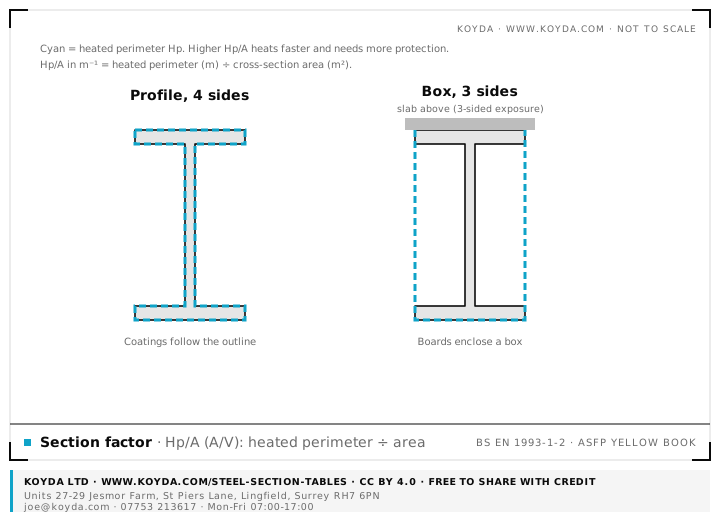
For a profile (coating) protection, the heated perimeter follows the outline of the section. For a box (board) protection, it is the perimeter of the box. A beam supporting a slab is usually heated on three sides. Section factors for UK sections are tabulated in the SCI Blue Book and the ASFP Yellow Book.
Use the paint and galvanising area calculator for the profile A/V (3 or 4 sides) and the coating area of each UB, UC and box section.
Types of protection
- Thin-film intumescent coatings: applied off-site or on site. Keep the steel shape visible.
- Boards: fixed around the section as a box. Tested to BS EN 13381-4.
- Sprayed non-reactive coatings: usually for hidden steelwork.
- Concrete encasement and filling: less common in new buildings.
Specifying
- State the fire resistance period, the exposure for each member, and the design temperature from the engineer.
- Specify compatible primer and topcoat, and the corrosivity category (see galvanising, powder coating and duplex).
- Use third-party certified products and applicators, and check dry film thickness on completion.
We have not reproduced Approved Document B's tables of fire resistance periods because they depend on building purpose, height and sprinklers; use the current ADB or a fire engineer.
Frequently asked questions
What is intumescent paint?
A thin coating that swells into an insulating char when heated, slowing the rise in steel temperature. Its thickness is specified as a dry film thickness from the manufacturer's tested data.
What does R60 mean?
The member must keep its load-bearing capacity for 60 minutes in the standard fire test. The 'R' is from the BS EN 13501-2 classification; E (integrity) and I (insulation) apply to separating elements such as walls.
What is section factor Hp/A?
The heated perimeter of the steel divided by its cross-section area, in m⁻¹. Thin, light sections have high section factors and heat up quickly; heavy sections have low section factors. Protection thickness increases with section factor.
Can intumescent paint be used outside?
Only with a system the manufacturer has assessed for external exposure, usually with a suitable primer and topcoat. Durability and maintenance need to be planned, and the manufacturer's application specification followed.
Who decides the fire protection thickness?
The specialist applicator or manufacturer, using tested and assessed data for the actual sections, exposure, fire period and design temperature given by the designer. Third-party certified products and installers are recommended.
Sources
- SteelConstruction.info: structural fire resistance and steel fire protection (section factor, intumescent coatings)
- SteelConstruction.info: fire protecting structural steelwork
- ASFP Yellow Book: fire protection for structural steel in buildings (Association for Specialist Fire Protection)
- Approved Document B: fire safety, Volumes 1 and 2, Appendix B fire resistance (GOV.UK)
- BS EN 13381-8 test methods for contribution to fire resistance: applied reactive protection to steel; BS EN 13501-2 classification; BS 476-20/21 (BSI)
General guidance only, not design advice for a specific project. Building regulations guidance changes: check the current edition of each document, and get project-specific design from a competent engineer. Koyda Ltd accepts no liability for decisions made using this page.