
Quick reference
| Property | S275 | S355 | Source |
|---|---|---|---|
| Yield strength, t ≤ 16mm | 275 N/mm² | 355 N/mm² | BS EN 10025-2 |
| Yield, 16 < t ≤ 40mm | 265 N/mm² | 345 N/mm² | BS EN 10025-2 |
| Yield, 40 < t ≤ 63mm | 255 N/mm² | 335 N/mm² | BS EN 10025-2 |
| Yield, 63 < t ≤ 80mm | 245 N/mm² | 325 N/mm² | BS EN 10025-2 |
| Tensile strength (min), 3 < t ≤ 100mm | 410 N/mm² | 470 N/mm² | BS EN 10025-2 |
| Modulus of elasticity E | 210,000 N/mm² | 210,000 N/mm² | BS EN 1993-1-1 |
| Density | 7,850 kg/m³ | 7,850 kg/m³ | BS EN 1991-1-1 |
Key points
- The number in S275 and S355 is the minimum yield strength (N/mm²) for material up to 16mm thick.
- Yield strength falls a little for thicker material: S355 is 345 N/mm² from 16 to 40mm.
- Both grades have the same density (7,850 kg/m³) and stiffness (E = 210,000 N/mm²).
- JR, J0, J2 and K2 are toughness sub-grades, chosen to BS EN 1993-1-10.
- An RSJ has tapered flanges; a UB has parallel flanges. 'RSJ' is often used loosely for both.
Terms explained in the A–Z glossary.
Download
Two-page summary of the figures on this page, with sources. Free to share with credit to Koyda Ltd.
Toughness sub-grades
| Sub-grade | Charpy impact energy | Test temperature |
|---|---|---|
| JR | 27J | +20°C |
| J0 | 27J | 0°C |
| J2 | 27J | −20°C |
| K2 | 40J | −20°C |
A full designation reads, for example, S355J2+N: grade S355, sub-grade J2, delivered normalised or normalised rolled. Hollow sections to BS EN 10210-1 use similar designations, with an H suffix.
Other properties used in design
- Shear modulus G ≈ 81,000 N/mm²; Poisson's ratio ν = 0.3.
- Coefficient of thermal expansion α = 12 × 10⁻⁶ per °C.
- The UK National Annex to BS EN 1993-1-1 lets designers use the minimum yield strength for the actual thickness as fy.
RSJ vs UB
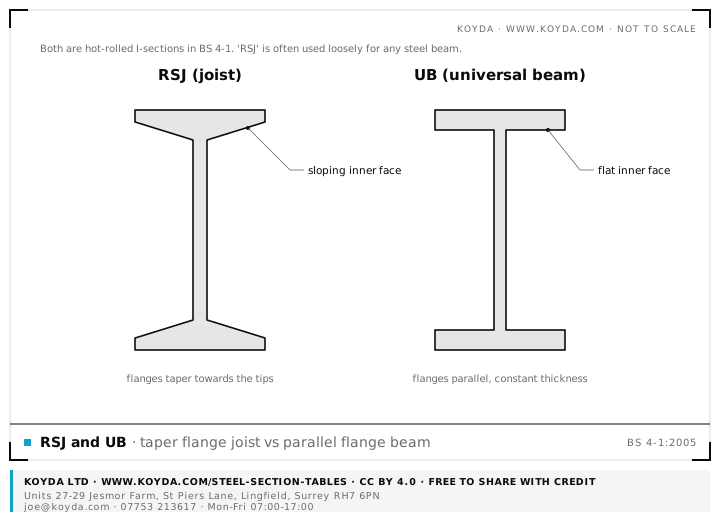
- RSJ (rolled steel joist): a hot-rolled I-section with flanges that taper towards the tips. BS 4-1 lists these as joists.
- UB (universal beam): a hot-rolled I-section with parallel flanges, much deeper than it is wide. Parallel flanges make bolting and welding simpler.
- UC (universal column): like a UB but with flange width close to the depth, for columns.
- On site and in quotes, 'RSJ' usually means 'a steel beam'. For pricing and fabrication, use the full designation, for example 203 × 133 × 25 UB S355.
See the UB section table and the steel weight calculator.
Frequently asked questions
What is the difference between S275 and S355 steel?
The minimum yield strength: 275 N/mm² for S275 and 355 N/mm² for S355, for material up to 16mm thick. Both have the same density and stiffness, so S355 carries more load before yielding but deflects the same amount under the same load.
Is S355 more expensive than S275?
S355 usually costs a little more per tonne, but because it is stronger the designer can often use a lighter section. S355 is now widely used for hot-rolled sections in UK building structures. Ask your supplier for current prices and availability.
What do JR, J0, J2 and K2 mean?
They are impact toughness sub-grades. JR, J0 and J2 need 27J in a Charpy test at +20°C, 0°C and −20°C respectively. K2 needs 40J at −20°C. The engineer chooses the sub-grade using BS EN 1993-1-10, based on thickness, stress and the lowest service temperature.
Is an RSJ the same as a UB?
Not strictly. An RSJ (rolled steel joist) has flanges that taper towards the tips. A UB (universal beam) has parallel flanges. Both are in BS 4-1, but 'RSJ' is widely used to mean any steel beam, including UBs. Check the actual section designation on the drawing.
Can I swap S275 for S355?
Using S355 in place of S275 with the same section size does not reduce strength. Using a lighter section in S355 needs the engineer's check, because stiffness, buckling and connections may govern rather than yield strength.
Sources
- SteelConstruction.info: steel material properties (BS EN 10025-2 yield and tensile strengths, sub-grades, E, G, ν, α)
- BS EN 10025-2:2019 hot rolled products of structural steels: non-alloy structural steels (BSI)
- BS 4-1:2005 structural steel sections: specification for hot-rolled sections (BSI)
- BS EN 1993-1-1 and UK National Annex: design of steel structures (BSI)
General guidance only, not design advice for a specific project. Building regulations guidance changes: check the current edition of each document, and get project-specific design from a competent engineer. Koyda Ltd accepts no liability for decisions made using this page.